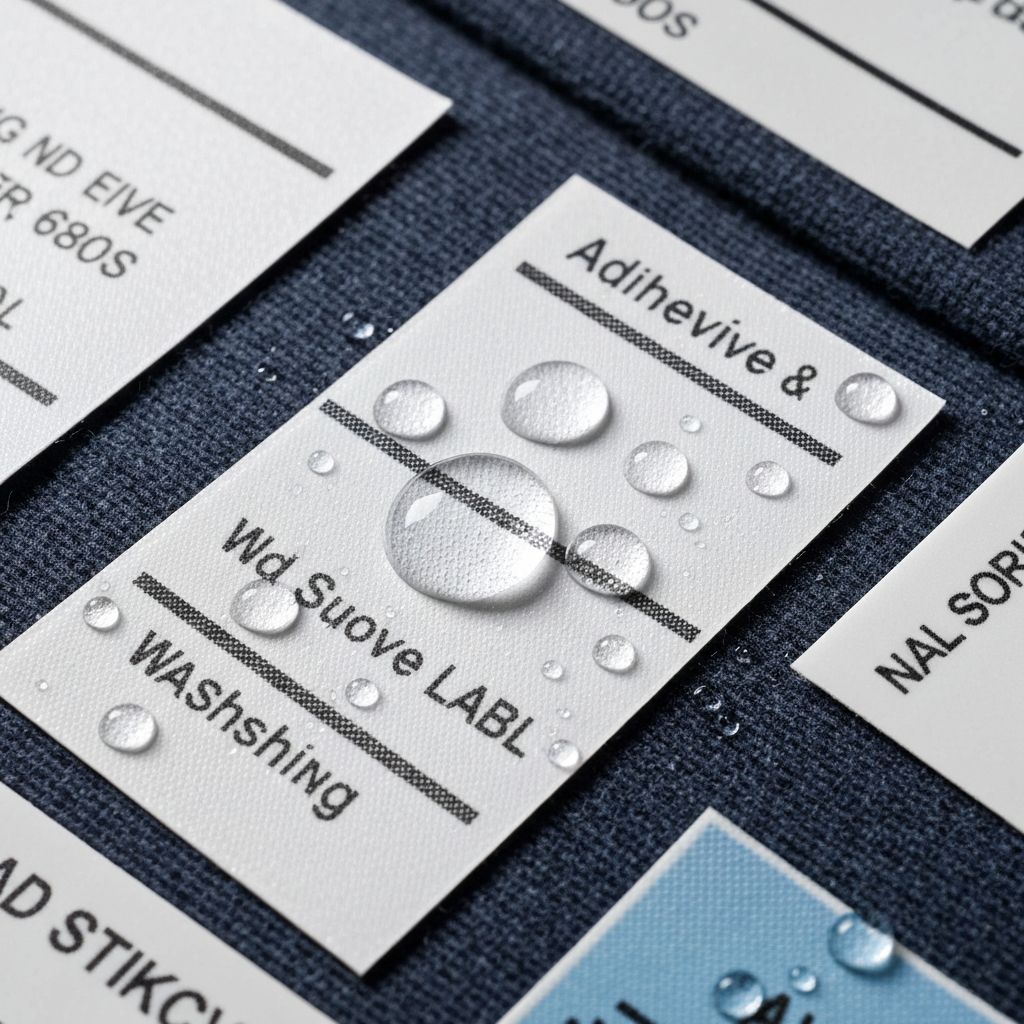
When Your Label Peels Off After Three Washes — The Science Behind Wash-Resistant Self-Adhesive Labels That Actually Stay On
Understanding adhesive chemistry, surface treatment, and barcode readability
Introduction: What Happens When a Label Fails
A care label peels off inside a washing machine. A barcode smudges to the point scanners reject it at the warehouse. A garment ships without proper identification because the adhesive gave up somewhere between the factory floor and the consumer's closet.
These are not hypothetical scenarios. They happen every day across garment supply chains, and the root cause is almost always the same—someone treated self-adhesive labels as a commodity purchase. They are not.
The Adhesive Layer: Pressure-Sensitive Chemistry 101
What Is Pressure-Sensitive Adhesive, Actually?
Pressure-sensitive adhesives, or PSAs, are weird materials. They stick just by applying light pressure—no heat, no water, no solvent activation needed. You peel the liner, press the label onto a surface, and that should be it.
Acrylic-based PSAs dominate the label industry today because polyacrylates are relatively cheap, resist aging well, and hold up against oxygen and UV radiation. What matters for practical purposes are three properties: tack (how quickly it grabs), peel adhesion(how hard it is to pull off), and shear strength (how well it holds position under force).
The Wash-Resistance Problem
Here is where garment labels depart from everything else in the self-adhesive world. A shipping label on a cardboard box lives an easy life. A care label inside a T-shirt goes through literal torture: hot water, detergent, mechanical agitation, fabric softener, high-heat drying cycles.
This is why wash-resistant labels demand fundamentally different adhesive formulations. Regular acrylic PSAs will soften in hot water, lose bonding strength, and eventually delaminate from the fabric.
Comparing Adhesive Types for Garment Labels
| Adhesive Type | Wash Durability | Residue Risk | Best Application |
|---|---|---|---|
| Standard acrylic PSA | Fair—decent initial tack but loses grip after 5–10 wash cycles | Low | Temporary labels, promotional wear, sample garments |
| Wash-resistant acrylic PSA | Good to excellent—holds through 30+ wash cycles at 40–60°C | Low | Permanent care labels, brand labels on cotton and polyester blends |
| Hot-melt PSA (washable grade) | Excellent—suitable for hot water wash up to 80°C, resists caustic baths | Low to moderate | Industrial laundry, uniforms, hospitality textiles |
| Silicone PSA | Moderate to good—very temperature stable but lower initial adhesion | Very low | Specialty fabrics, delicate materials |
| Rubber-based PSA | Good initial tack, poor wash durability—degrades in hot water | Moderate to high | Not recommended for washable applications |
The Water Absorption Variable
Water is the enemy of adhesion. When a label absorbs moisture during washing, two bad things happen. First, water molecules migrate into the adhesive layer and plasticize it—essentially turning it softer and weaker. Second, water at the adhesive-fabric interface creates a boundary layer that prevents proper bonding.
Wash Resistance: The Real Test of a Self-Adhesive Label
What "Washable" Actually Means
Industry terminology gets sloppy here. "Washable" means different things depending on who you ask. For one manufacturer it means surviving three gentle cycles. For another it means withstanding boiling water and industrial detergent.
The more honest term is "wash durable." A wash-durable label maintains both physical adhesion and print legibility through the expected number of laundering cycles for the intended application. For home-wear garments, 25–30 cycles at 40°C might be sufficient. For hotel linens and healthcare uniforms, you are looking at 75–100 cycles at 70°C or higher.
Heat, Detergent, and Mechanical Stress
Each wash cycle attacks the label on three fronts simultaneously:
- Chemical attack: Detergents are formulated to break down oils and organic materials. Acrylic adhesives are organic materials. Good wash-durable adhesives need proper crosslinking density to resist detergent penetration.
- Thermal stress: Water at 60°C softens most PSAs dramatically. An acrylic adhesive that holds 15N/inch peel strength at room temperature might drop below 3N/inch in hot water.
- Mechanical abrasion: The label is rubbing against other garments, against the drum, against itself. Face stock abrasion gradually degrades the printed surface.
Surface Treatment: Where Scanning Reliability Is Born
It Is Not Just About Ink
Most discussions about barcode quality start and end with the printer. This misses half the equation. The surface of the label material—its whiteness, its reflectivity, its smoothness—has a significant impact on reading results.
For barcode label customization, this means face stock selection is not a cosmetic decision. It is a functional one. A white polyester face stock with a matte finish gives you the contrast and low reflectivity that both laser scanners and camera-based readers need.
Surface Coatings and Print Anchorage
Thermal transfer printing, the dominant method for custom barcode label production in garment applications, requires the face stock to accept and anchor the resin or wax-resin ink. A properly coated surface produces uniform 2D barcode cells with sharp edges.
Barcode Readability: It Is Not Just About the Printer
Print Resolution, Label Surface, and Scanner Compatibility
The rule of thumb: print barcodes at 300 DPI or higher. Anything less and you are gambling on scan reliability, especially for small codes like those found on garment care labels.
But resolution alone is not the answer. The interaction between print settings, label surface, and scanner hardware creates a system-level challenge. Common causes of poor barcode print quality include dirty or carbonized printheads, mismatched print density and speed settings, and poor-quality thermal label media with inconsistent coating thickness.
Barcode Quality Factors
| Quality Factor | Technical Requirement | Practical Impact |
|---|---|---|
| Symbol Contrast | ≥70% per ISO/IEC 15416 | Higher contrast means faster, more reliable scans |
| Edge Definition | Minimal roughness and voids | Sharp barcode edges reduce misreads and no-reads |
| Quiet Zone | ≥10× X-dimension for linear codes | Interference from nearby graphics causes scan failure |
| Print Resolution | ≥300 DPI | Below 300 DPI, small codes lose scannable detail |
| Surface Reflectivity | Matte white finish preferred | Glossy surfaces cause laser scatter and reading errors |
What Garment Trim Manufacturers Need to Get Right
The Adhesive-Face Stock-Process Triangle
Think of label performance as a triangle. One side is the adhesive chemistry. One side is the face stock material and surface treatment. One side is the printing and converting process. Weaken any side, and the whole structure fails.
Testing Before Full Production
There is no substitute for actual wash testing under realistic conditions. Every fabric type interacts differently with adhesive chemistry—a label that bonds beautifully to smooth cotton may peel immediately from textured polyester or nylon.
For self-adhesive label adhesive performance verification, the testing protocol should include:
- Multiple complete wash-dry cycles (minimum 25 for standard home-wear applications, 75+ for industrial laundry)
- Print legibility checks after wash cycles
- Scan testing on actual production barcode scanners
Market Context
The global self-adhesive label market was worth approximately USD 49.8 billion in 2024, with forecasts projecting growth to around USD 70.2 billion by 2031 at a CAGR of roughly 5.1%.
Within this massive industry, garment labels and hang tags represent a distinct and growing segment. The global garment tags and labels market reached roughly USD 2.9 billion in 2023 and is projected to grow to about USD 4.5 billion by 2030 at a CAGR of around 6.8%.
Need Custom Garment Accessories?
From hang tags to woven labels, we manufacture premium garment accessories tailored to your brand's needs.
Get a Free Quote